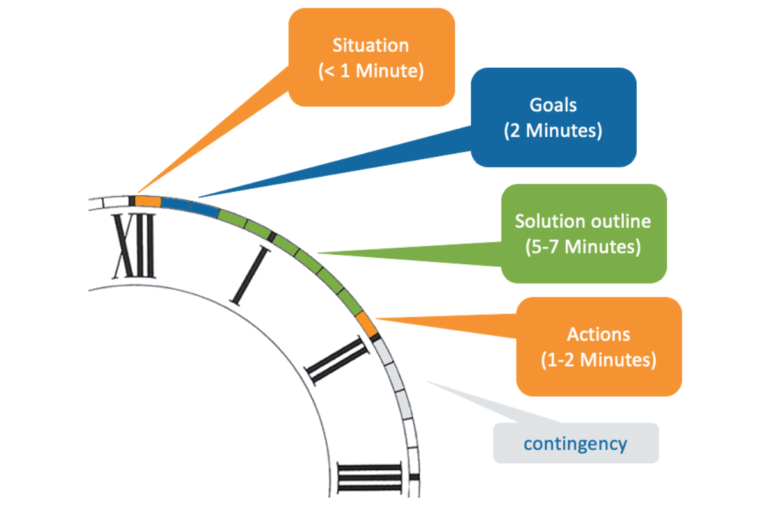
Imagine how good it would feel to have a positive impact on another person’s life within the shortest of times. Sometimes you only have a few minutes. For example, when someone approaches you in the coffee corner at a customer’s office. Yet you still want to support them. Do you have 10 minutes for this person and for yourself?
This coaching format can be a helpful addition to your toolbox.
Situation AsseSsment (<1 minute)
Objective: Find out quickly what the topic is.
You can start with one of the following questions:
- What brings you to me?
- What is it about?
- What’s on your plate?
- What’s up?
Determine Goal (2 minutes)(s)
Objective: Find out what support is needed right now
Possible questions:
- What can we discuss now so that you can solve this problem well?
- What sort of support do you need from me?
- What can we discuss briefly so that you can handle the tasks?
- What would be a good result for you in the next minutes, so that you can continue working on the topic?
Get Solution outline (5-7 Minutes) outline
Objective: Outline success criteria and solution
Possible questions:
- What possibilities do you have to solve the issue?
- Which possibility have you not yet thought of?
- How would you recognize a good solution?
- Which important criteria indicates your solution’s success?
- What characteristics would a good solution have?
- Assuming you have an idea for a good solution, what would you have to do to destroy it?
- How would your best colleague solve the issue?
Actions (1-2 Minutes)
Objective: Determine how they want to proceed
Possible questions:
- Which first step will you take now?
- If we stop here now, which of these will you implement immediately?
- What will you tell your partner tonight, about what steps you have taken today to solve the problem?
(*) See: Radatz, 2010

Related Posts
High-Performance Teams Thanks to Agile Transformation
In an era when companies must constantly face new challenges, effective teamwork plays a crucial role. Here is where Yes and Why GmbH comes in, a consultancy that specializes in transforming less effective teams into high-performance teams through agile transformation. Want to learn more about what an agile mindset truly means? Read our detailed article…
The hidden costs of „Calender-Tetris“
TL;DR If your agile transformation feels like “even more meetings,” that’s often not a mindset problem. It’s a structural one. Frequent context switching creates switching costs. People are busy, but delivery slows down. Scrum can improve this—but only if you don’t pile it on top of project governance. The lever is calendar and coordination design:…
Prime Directive 2025: A modern foundation for safe and effective retrospectives
Modern teams need a Prime Directive that goes beyond good intentions. The new version creates real learning space: safe, confidential and grounded in clear ethics.
ZEIG: A New Framework for Truly Feasible User Stories
Many teams work with well-written User Stories and still run into uncertainty, delays, or hidden dependencies. A story can be perfectly structured – and still not feasible. Feasibility is an often overlooked quality criterion in agile product development. It describes whether a team can reliably carry a story – technically, professionally, organizationally, and socially. Feasibility…
Subscribe Here!